.png)







Key takeaways
- When Mora began missing developmental milestones as an infant, her parents trusted their instincts and pursued genetic testing.
- Microarray testing did not identify a cause, but exome sequencing through GeneDx provided a diagnosis of SYNGAP1-related disorder (SRD).
- Because Mora was diagnosed early, her care team could proactively monitor for seizures, a common feature of SRD.
- Early diagnosis enabled earlier interventions, specialist care, and access to resources that may otherwise have been delayed.
- A genetic diagnosis also connected Mora’s family with a community, clinical expertise, and a clearer path forward.
When missed milestones led Mora’s family to seek answers
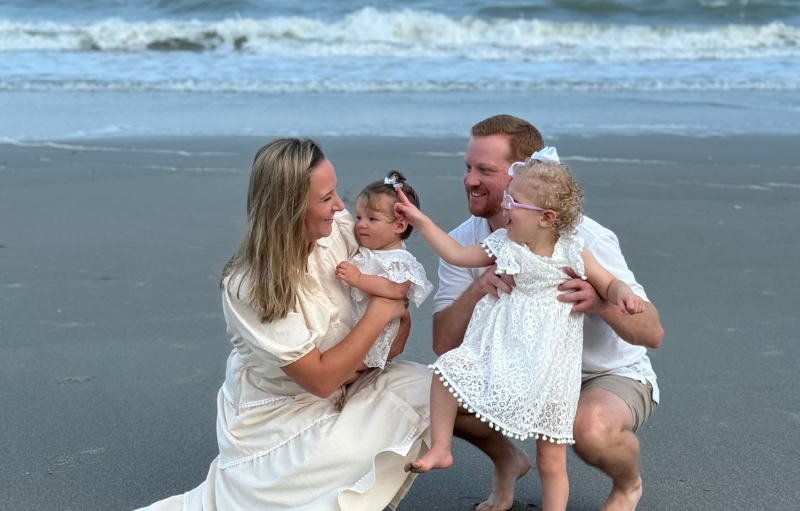
For Sara Driscoll and her husband, Jesse, Mora's infancy looked typical at first. But around eight months old, they noticed she wasn't meeting developmental milestones at the same pace as her peers. Mora was unable to get herself into a sitting position independently and struggled to maintain it for long periods.
After connecting with their state's early intervention program, a physical therapist confirmed that Mora had low muscle tone. Like many families, they were encouraged to take a "wait-and-see" approach. “Children develop at different rates: she might catch up on her own,” they were told.
But for Sara, waiting without answers felt risky. "We knew early intervention is most effective when children receive support as soon as possible," she says. "If there was an underlying cause, we wanted to know what it was so we could make informed decisions for Mora."
That decision to keep asking questions would ultimately change the course of Mora's care.
When initial genetic testing didn’t provide an answer
As the months passed, Mora continued to fall behind her peers developmentally. Her parents also noticed additional concerns, including episodes where her eyes would cross when she became tired.
The family suspected that whole exome sequencing (WES) would give them the comprehensive answers they were looking for. With that in mind, they sought out a genetics consultation, hoping the visit would ultimately pave the way toward exome testing.
As part of that process, they first completed CMA, which came back negative.
For many families, negative results can bring a sense of relief. But Sara and Jesse still felt there was more to learn.
"As two engineers, we wanted more data," Sara explains. "We wanted to understand what we were seeing rather than simply waiting for symptoms to become more obvious."

With the CMA results in hand, the family moved forward with the whole exome sequencing they had hoped for from the start, pursuing testing through GeneDx. By analyzing thousands of genes at once, exome sequencing offered a more comprehensive opportunity to identify a genetic explanation for Mora's symptoms - one that CMA alone had not been able to detect.
The decision to pursue comprehensive testing early proved critical.
How exome sequencing led to Mora’s SYNGAP1 diagnosis
On November 27, Sara received the call that would forever change their family's journey. Exome sequencing identified a de novo pathogenic variant in the SYNGAP1 gene, confirming SYNGAP1-related disorder (SRD), a rare neurodevelopmental condition associated with developmental delays, intellectual disability, and a high prevalence of epilepsy.
To Mora’s providers, the diagnosis came as a surprise, expecting the results to be normal--- for Sara and Jesse, it was validation.
But the diagnosis revealed something even more important: children with SYNGAP1-related disorder have a significant risk of developing epilepsy. Their genetic counselor immediately recommended scheduling a neurology appointment. At the time, Mora had not yet experienced obvious seizures. That early warning gave the family something many rare disease families never receive: time.
An Early SYNGAP1 diagnosis enabled proactive seizure care
For Sara, the greatest value of exome sequencing wasn't simply receiving a name for Mora's condition.
It was receiving that answer before serious symptoms emerged.
Because the family knew epilepsy was common in SYNGAP1-related disorder, they were able to establish neurological care and closely monitor Mora for seizure activity.
Soon afterward, Mora began experiencing subtle eyelid myoclonia—brief eyelid flutters that can easily be overlooked or mistaken for normal blinking.
Because her family knew what to watch for, they acted quickly.
An EEG confirmed epilepsy.
Without the diagnosis, those early seizure signs may have gone unnoticed for much longer.
Instead, Mora's family was able to begin addressing her epilepsy at the earliest possible stage.
For the family, “the genetic report did not change who Mora was. It changed what was possible for her future.”
Finding the SYNGAP1 community earlier
The benefits of an early diagnosis extended beyond medical care.
Rather than spending years walking this journey alone, Sara and Jesse were able to connect with experienced families immediately after diagnosis.
Through the CURE SYNGAP1 community, the family confided with parents who understood their journey and could share practical insights about treatments, therapies, and daily life.
The community became a source of education, support, and hope— continuing to shape Mora’s care today.
The Impact of getting a genetic diagnosis early
Mora's story underscores the importance of early diagnosis in rare disease. Every month spent searching for answers can mean missed opportunities for monitoring, intervention, and specialized care. While a diagnosis cannot eliminate the challenges of a rare genetic condition, receiving that diagnosis early can help families and clinicians make informed decisions sooner—often before complications become more severe.
For Mora, early genetic testing led to early epilepsy detection, early specialist involvement, early intervention, and early access to a community that understood her journey. "Early diagnosis replaced uncertainty with direction, isolation with community, and waiting with action," Sara says.
For families navigating developmental delays or unexplained medical concerns, Mora's story is a reminder that seeking answers early can make a meaningful difference—not only in understanding a diagnosis, but in unlocking opportunities for care, support, and action when they matter most.
Wondering if genetic testing is right for your child?
Exome or whole genome sequencing can help identify the underlying cause of developmental delays, unexplained symptoms, or complex medical histories.
In some cases, it can also uncover additional health risks and inform care for additional family members.
If you think genetic testing may be appropriate for your child, talk with your doctor about next steps or read our genetic testing guide for families.