.png)






Key takeaways
- A negative prenatal screening result does not rule out all rare genetic conditions
- Rapid genome sequencing in the NICU gave Cayden’s family an answer within about a week, moving them from uncertainty to an informed care plan.
- Cayden’s diagnosis led to proactive specialist evaluations, targeted monitoring, and early intervention—and helped his family advocate for a safe discharge home rather than a potentially extended NICU stay.
- His CFC syndrome diagnosis supported access to therapies, communication and mobility equipment, and additional early intervention resources.
When a negative prenatal screening gave false security
When Mairin Jameson was pregnant with her first child, she thought pre-natal genetic screening had already given her reassurance that everything was on track.
She had completed noninvasive prenatal screening (NIPS) at 10 weeks, and the result was negative. “In my mind, I was like, ‘Oh, great—everything’s great,’” she recalls. “That’s what I knew about genetic screening at that point.”
Like many expectant parents, Mairin didn't realize that while NIPS screened for certain common chromosomal findings during pregnancy, it does not test for rare genetic disorders that are often only identified through diagnostic genetic testing.
But as her pregnancy progressed, there were signs that something more might be going on.
At the 20-week anatomy scan, providers noticed concerns related to her son, Cayden’s, kidneys. Follow-up ultrasounds showed the issue worsening, and Mairin’s care was transitioned to high-risk monitoring.
Later, she was diagnosed with polyhydramnios (an excess of amniotic fluid) and experienced preterm labor. Despite these complications, a genetic condition was never discussed as a possible underlying cause and genetic testing was never discussed or recommended. At 32 weeks, Mairin’s water broke. Cayden was born by C-section at 33 weeks and began his life in the NICU.
What happened next gave their family answers, and a path forward, far sooner than they ever expected.
An unexpected opportunity for answers through rapid genome sequencing
Because of concerns about his kidney function, Cayden was transferred to Seattle Children’s Hospital. There, the family learned about a rapid genome sequencing study, called SeqFirst, available to infants in the NICU whose clinical features could not be fully explained by infection, prematurity or physical trauma. The goal was to quickly identify an underlying genetic cause that could help guide diagnosis, treatment, and medical management during a critical window of care.
As someone who works in the medical field, Mairin has always valued information. When she learned about the study, she agreed to participate. At the time, though, she did not expect testing to find anything. “I honestly did it because I thought, if we can help science, then great,” she says. “I truly thought it was going to come back negative.”
About a week after the blood draw, while Cayden was still just two weeks old, Mairin received a call with life-changing news: rapid genome sequencing identified a pathogenic variant in the MAP2K1 gene, confirming a diagnosis of cardio-facio-cutaneous (CFC) syndrome, a rare genetic condition that can affect multiple parts of the body, including the heart, brain, growth, and development. The condition can impact several organ systems, and diagnosing it early can help inform ongoing evaluation and care.
The news was difficult to absorb, especially in the middle of an already overwhelming NICU experience. But the diagnosis quickly gave the family something they had not had before: clarity.
“It gave us so much direction on how to give better care for him and get him set up with all the resources to help him meet his full potential,” Mairin says.
Genetic diagnostic insights that led to immediate action
A rapid genetic diagnosis in the NICU gave Cayden’s care team and family the information they needed to make informed decisions about his treatment and care from the beginning.
With CFC syndrome identified early, Cayden’s care team could proactively evaluate for health concerns associated with the condition and establish a baseline for ongoing care. Before Mairin’s maternity leave ended, Cayden had already been evaluated by cardiology, neurology, ophthalmology, and other specialists, giving the family a clear plan for monitoring his health as he grew. The diagnosis also informed decisions during Cayden’s NICU stay.
Because CFC syndrome commonly causes feeding difficulties, Mairin felt better equipped to advocate for her son when he struggled to feed. Initially, his care team believed his challenges were primarily related to prematurity and anticipated a much longer hospital stay. But with a confirmed genetic diagnosis, Mairin could explain that his feeding difficulties were consistent with CFC syndrome... not just prematurity.
Once his care team confirmed he could safely continue feeding through a nasogastric (NG) tube at home, the family was able to leave the NICU weeks earlier than expected.
“They taught me how to put in the NG tube, and we went home,” she says. “Without the diagnosis, we could have been in the NICU for two or three more months.”
Early intervention from day one
Although receiving a genetic diagnosis in the NICU was an emotional experience, the diagnosis also helped Mairin’s family act quickly on developmental support. Cayden was enrolled in early-intervention services, including physical, occupational, and speech therapy, starting from the moment they got home.
“Had we gotten a diagnosis when he was two, we would have had to pivot and start all of those appointments then,” Mairin says. “Instead, we were able to get everything established early.”
This proactive approach was especially critical when it came to neurology. Because children with genetic variants in MAP2K1 are at risk for seizures, Cayden had already established care with a neurologist. When he experienced his first major seizure, the family did not have to wait weeks for a referral or an appointment; they were able to contact his neurologist right away and start medication immediately.
A genetic diagnosis that supports access to services and medical devices
Beyond medical monitoring, the diagnosis helped the family navigate the practical realities of insurance and access to care. As Cayden grew, he needed equipment like a gait trainer, an AAC communication device, and a wheelchair to support his development.
“Without a diagnosis, there’s no way we would have gotten approval for all those things as easily,” Mairin explains. “Having a diagnosis speaks for itself. It makes it way easier than having to explain that he is just ‘delayed’ without knowing why.”
The diagnosis provided documented medical evidence for the services and equipment Cayden needed, helping the family access resources that support his health, communication, mobility, and independence.
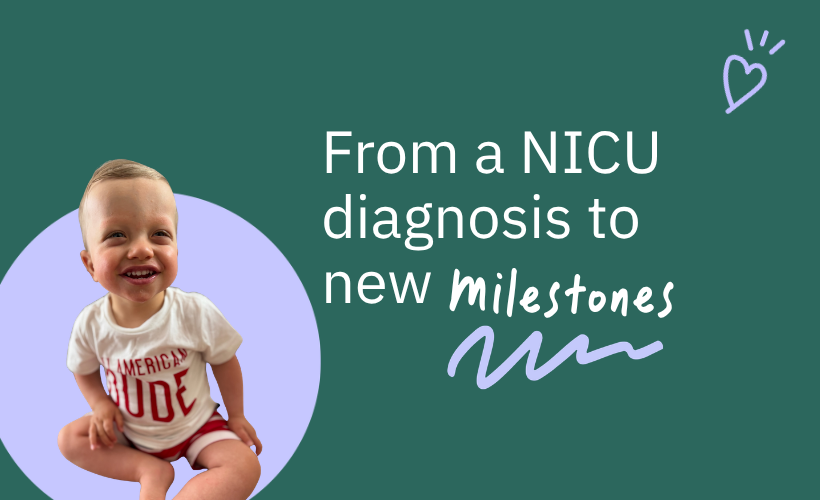
Today, Cayden is approaching his third birthday and continues to reach new milestones. He communicates through signs, vocalizations, and his Augmentative and Alternative Communication (AAC) device, and he is working toward standing independently with determination.
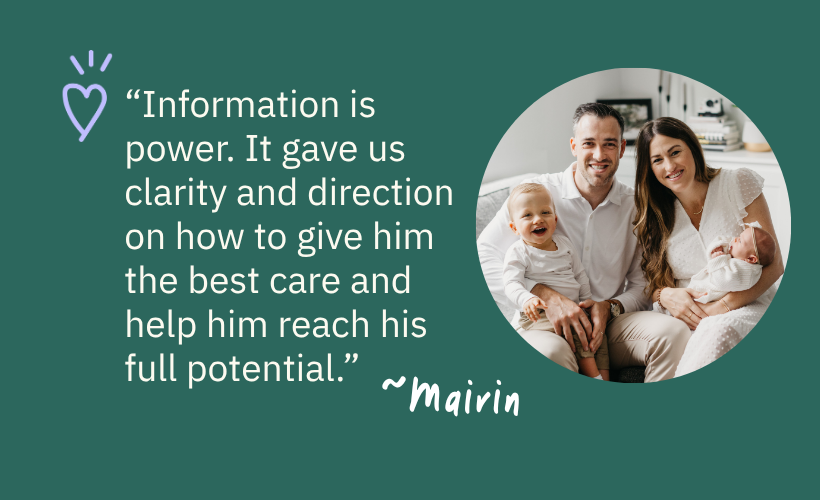
"Information is power,” Mairin says. “It gave us clarity and direction on how to give him the best care and help him reach his full potential.”
Advice for other families
Mairin encourages families facing unexplained health concerns, or NICU stays, to trust their instincts and seek the information that genetic testing can provide.
Mairin encourages expectant parents to ask questions when prenatal ultrasounds or other screenings raise concerns. Many prenatal diagnostic tests, including chromosomal microarray analysis (CMA), cannot identify all genetic conditions. In some situations, diagnostic testing through amniocentesis followed by prenatal exome or genome sequencing may be available, which can evaluate for a broader range of genetic changes.
For families experiencing findings such as fetal kidney differences and differences in amniotic fluid volume, like Mairin, or other unexplained fetal differences during pregnancy, speaking with a maternal-fetal medicine specialist or genetic counselor can help them understand whether more comprehensive prenatal genetic testing may be appropriate. Earlier answers can help families and care teams prepare for a baby’s needs before birth and make informed decisions about care.
To learn more about the CFC and find support, she recommends connecting with organizations like CFC International.
“Our persistence paid off,” Mairin says. “It allowed us to act at the earliest possible time.”
Why early genetic testing matters
In the NICU, infants can present with complex symptoms without a clear explanation. Timely genetic testing can provide critical answers when they matter most, helping care teams make more informed decisions about specialist referrals, medical monitoring, treatment decisions, and discharge planning. For families like Cayden’s, it meant beginning therapies and establishing care sooner. Rapid genome sequencing has been shown to change clinical management for critically ill infants and may reduce NICU length of stay 1,2, allowing families to move from uncertainty toward an actionable plan for their child’s care.