.svg)







Key takeaways
- GeneDx and Canadian clinicians and researchers have collaborated on 15 peer-reviewed publications in the past ~18 months.
- Six genes—GABRA3, NDUFA13, PRMT9, DENND2B, XPO1, BORCS5—were upgraded upon publication.
- These efforts highlight the power of collaborative data sharing and a commitment to supporting the global rare disease community.
Advancing a shared mission
Progress in rare disease diagnosis depends on more than advanced technology. It requires collaboration among industry, clinicians, researchers, and families who are willing to share data and insights to expand our collective understanding of genetic disease.
Over the past year and a half, clinicians and researchers across Canada have contributed to 15 peer-reviewed studies—a majority of which included connections made through GeneMatcher—alongside GeneDx , strengthening the global rare disease knowledge base and uncovering new evidence for disease-causing genes and variants. These findings have helped unlock diagnoses not only for participating families, but for future patients worldwide.
GeneDx's collaboration with Canadian partners reflects a shared goal: accelerating discoveries for the global rare disease community and ensuring those discoveries reach patients as quickly as possible.
Transforming research into real-world impact
Every new gene-disease association has the potential to change a family's diagnostic journey. While peer-reviewed publications are important scientific milestones, their greatest value lies in how they translate into clinical care. A newly established gene-disease relationship can mean the difference between a non-diagnostic result and a definitive diagnosis for a patient.
The six genes upgraded as a direct result of these collaborations will help drive more diagnoses, better informed medical management, and greater access to appropriate resources and support:
- GABRA3 | “Functional consequence of pathogenic GABRA3 variants determines whether X-linked inheritance is dominant or recessive.” (Johannesen, Katrine M et al.)1
- NDUFA13 | “Biallelic NDUFA13 variants lead to a neurodevelopmental phenotype with gradual neurological impairment.” (Kaiyrzhanov, Rauan et al.)2
- PRMT9 | “Bi-allelic PRMT9 loss-of-function variants cause a syndromic form of intellectual disability.” (Kröll-Hermi, Ariane et al.)3
- DENND2B | “Variants in DENND2B are associated with vulnerability for neurodevelopmental impairment, psychosis and catatonia.” (Murthy, Harsha et al.)4
- XPO1 | “Pathogenic XPO1 variants cause a dominant neurodevelopmental disorder.” (van Oirsouw, Amber S E et al.)5
- BORCS5 | “Neuroaxonal Dystrophy With Osteopetrosis Associated With a Novel Biallelic Nonsense Homozygous Variant in BORCS5.” (Fisher, Yael et al.)6; “Pathogenic variants in BORCS5 cause a spectrum of neurodevelopmental and neurodegenerative disorders with lysosomal dysfunction.” (Mencacci, Niccolò E et al)7
Together with the additional collaborative efforts highlighted below, these studies showcase a range of meaningful advances in our understanding of genetic disease:
- SUPT16H | “SUPT16H-associated neurodevelopmental disorder and neurocristopathy: genetic and phenotypic spectrum.” (Lee, Eunhye et al.)8
- UNC13A | “Pathogenic UNC13A variants cause a neurodevelopmental syndrome by impairing synaptic function.” (Asadollahi, Reza et al.)9
- WNT4 | “WNT4 deficiency impacts heart, diaphragm, and palate development: Insights from human genetics, machine learning, and mouse models.” (Hernández-García, Andrés et al.)10
- COL18A1 | “Occipital Cephalocele, Polymicrogyria, Ocular Anomaly and Vermian Dysplasia: Prenatal Markers for Knobloch Syndrome.” (Carmant, Laurence Sophie et al.)11
- TRMT1 | “Bi-allelic pathogenic variants in TRMT1 disrupt tRNA modification and induce a neurodevelopmental disorder.” (Efthymiou, Stephanie et al.)12
- PHACTR4 | “De novo missense variants in the RPEL3 domain of PHACTR4 in individuals with overlapping congenital anomalies.” (Torti, Erin et al.)13
- CHD4 | “Discovery of a DNA methylation profile in individuals with Sifrim-Hitz-Weiss syndrome.” (Karimi, Karim et al.)14
- SET | “Delineating the clinical and molecular spectrum of the neurodevelopmental disorder associated with SET.” (Shi, Yuwei et al.)15
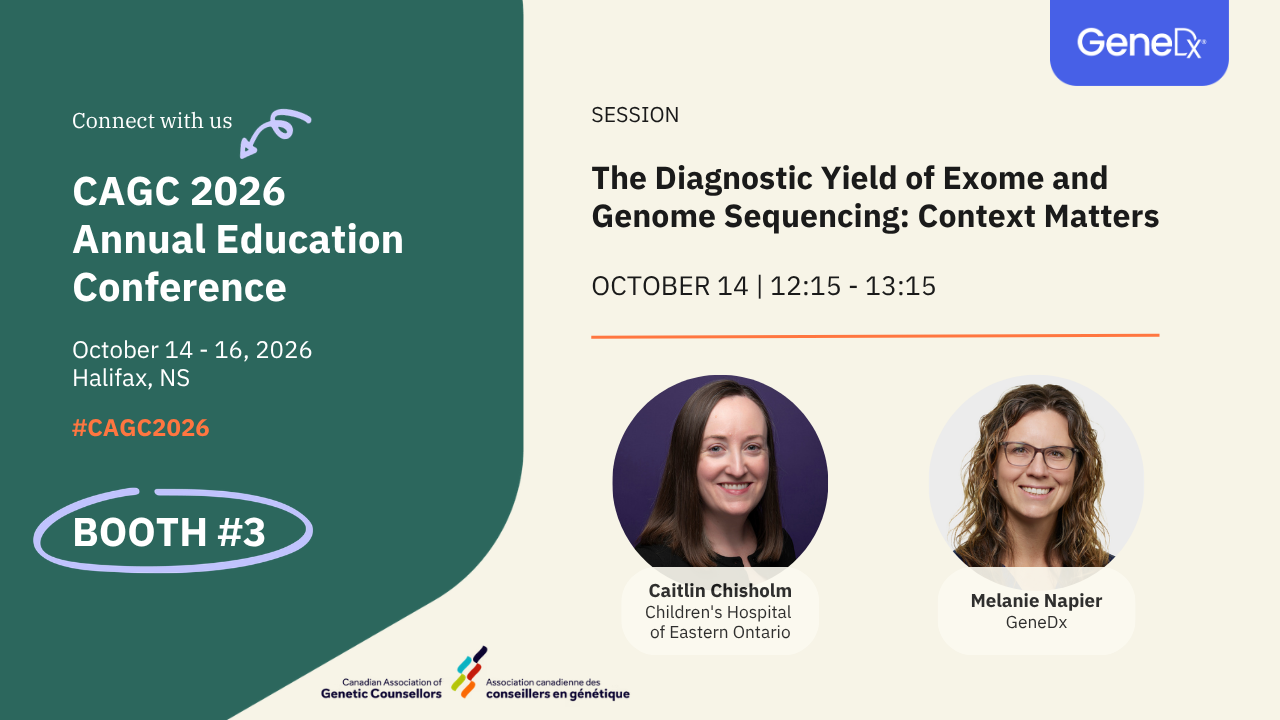
Join us at CAGC 2026 to learn more
144: Real-World Impact of GeneMatcher-Facilitated Collaborations
Wednesday, October 14, 2026 | 18:00–20:00
Knowledge that goes deeper
To date, GeneDx has curated over 10.5K gene-disease associations, with nearly 5,000 validated gene-disease associations, and more than 5,600 emerging associations.¹⁶ We contribute ~22% of total submissions to GeneMatcher, which have led to >500 new disease-gene relationships.¹⁷