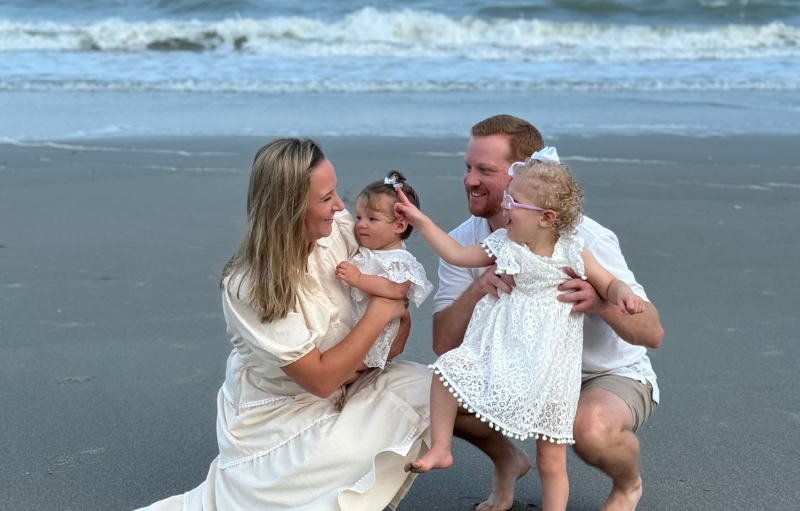
.png)




Key takeaways
- Genome sequencing identified Everly’s FRRS1L disease after prior genetic testing did not provide an answer.
- For rapidly progressive conditions like FRRS1L disease, earlier diagnosis may create opportunities for earlier care, research participation, and future treatments.
- Everly’s family is advocating for broader access to genomic newborn screening to help identify children before irreversible neurological damage occurs.
- Their family-led organization is also advancing a gene therapy program for FRRS1L disease.
Searching for an explanation for missed developmental milestones
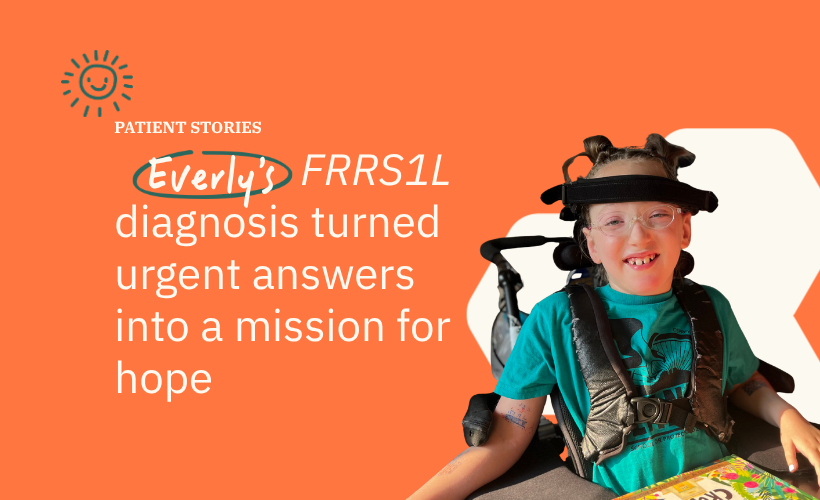
When Everly Green was about 7 months old, her parents knew something wasn't quite right. She was struggling to hold her head up and had missed several developmental milestones. Although she continued making gradual progress through extensive physical therapy, her delays remained unexplained.
Developmental delays can have many causes, with up to 50% of causes attributed to genetics. ¹ For Everly, however, initial genetic testing panels did not provide an answer.
At the recommendation of genetic specialists at the Kennedy Krieger Institute and Johns Hopkins, Everly underwent genome sequencing through GeneDx to look for an underlying genetic cause.
The results identified an ultra-rare condition, FRRS1L disease (also known as developmental and epileptic encephalopathy 37), caused by two disease-causing variants in the FRRS1L gene.
For her mother, Chrissy Green, the diagnosis finally explained what was happening—but it also came with devastating knowledge that rapid regression and global loss of function were ahead for her daughter.
What is FRRS1L disease?
Children with FRRS1L (pronounced “Frizzle”) disease often appear to develop normally during infancy before seizures begin and developmental skills rapidly disappear.
Loss of function of FRRS1L interferes with the proper building of AMPA receptors in the brain, which are essential for neurons in the brain to communicate with each other. In individuals with FRRS1L disease, disruptions in these neural signaling pathways result in severe epilepsy, movement disorder, rapid regression, global loss of function, additional health issues like respiratory failure, scoliosis, and lifelong disability. Children are trapped in a body they can’t move, but they are still inside and have cognitive understanding.
“The timeline is heartbreaking,” Chrissy says. “By the time many families receive a diagnosis, their child has already lost abilities that may never return."
An FRRS1L diagnosis: Knowing what they were fighting for
Although the diagnosis couldn’t stop Everly’s regression, it gave her family a clearer understanding of what they were fighting—and how to fight for her. Through twice weekly PT, and OT and speech therapy, Evelry’s family decided to keep her active, strong, and healthy as possible through severe regression. They discovered that the only thing left on Everly’s body that she could control were her eyes, and Everly proved all the doctors wrong - she was smart, capable, and wanted to communicate through an eye gaze computer. She was helping rewrite the information on her disease because of her diagnosis.
Today, Everly is eight years old.
She lies flat on a bed or strapped into a fully supportive wheelchair, but she understands everything happening around her and she is full of life. She attends school in a mainstream classroom with support, loves spending time with her brothers, and communicates using an eye-gaze computer.
Her body can no longer do what her mind wants it to do.
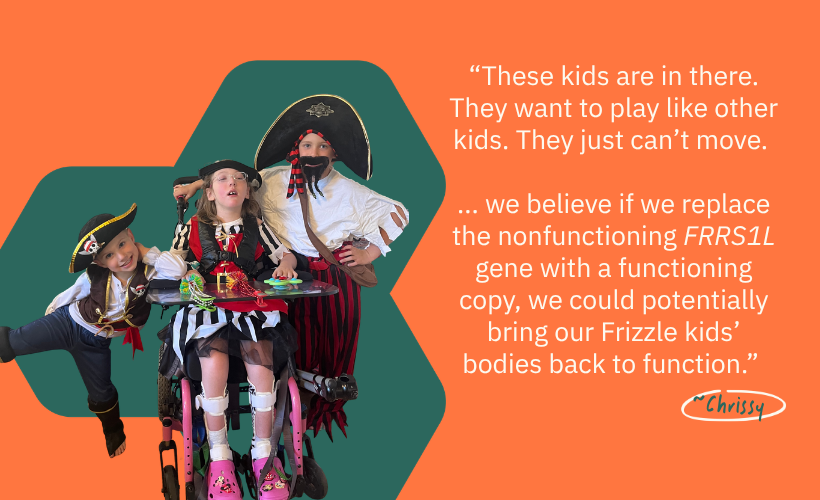
“These kids are in there,” Chrissy says. “They want to play like other kids. They just can’t move. Because of a diagnosis and research, we believe if we replace the nonfunctioning FRRS1L gene with a functioning copy, we could potentially bring our Frizzle kid’s bodies back to function. We have proved it in our animal models and are hopeful to start a clinical trial this fall.”
Why an early genetic diagnosis matters for FRRS1L disease
For many rare disease families, receiving a genetic diagnosis provides long-awaited answers and often a clearer path forward.
For FRRS1L disease, however, timing may mean something even more.
Everly received her diagnosis at about 18 months old through genome sequencing. For many rare diseases, that would be considered relatively early. But for FRRS1L disease, children can begin losing skills around age two... meaning even an early diagnosis may come after irreversible neurological damage has already begun.
Researchers believe that early therapeutic interventions are most likely to have the greatest impact before extensive neurological injury occurs. Once children lose critical brain function, restoring it becomes far more difficult.
That understanding has completely reshaped Chrissy's mission.
While Everly's diagnosis gave their family clarity, Chrissy now hopes future families won't have to wait until symptoms appear to receive answers... or better yet, treatment.
“If babies could be identified before they begin losing skills, we may have a chance to intervene much earlier,” she says.
That possibility is what fuels her advocacy for expanded newborn screening and broader access to genomic sequencing. Her hope is that more children can receive a diagnosis before irreversible damage occurs, creating the opportunity for earlier intervention and, one day, access to emerging therapies at a time when they may have the greatest impact.
From receiving answers to driving solutions
After Everly's diagnosis, Chrissy connected with a fellow Frizzle family who eventually co-founded their organization Finding Hope for Frizzle (FRRS1L).
With only around 100 known individuals worldwide living with FRRS1L disease, there was little commercial incentive for pharmaceutical companies to invest in developing a treatment.
Rather than waiting and hoping someone else would act, the families made a remarkable decision... they would lead the effort themselves.
Today, Chrissy serves as president of Finding Hope for FRRS1L, a parent-led rare disease organization taking an innovative approach to therapeutic development. Their small organization has taken on drug development and fully owns, manages, and funds their gene therapy program. They are developing a gene replacement therapy for FRRS1L disease faster and with less funding. They have brought together partners, vendors, and scientists across the industry to collaborate and support their treatment development program.
“We realized we would be the ones who would never give up on treatment, so we needed to be the ones owning it, running it, and funding it if we want to get treatment developed for all current and future Frizzle patients,” Chrissy says.
For Chrissy and the other families, a diagnosis wasn't the end of the journey, it was the beginning of a new mission: creating hope for every child and family who will receive an FRRS1L diagnosis in the future.
Accelerating the path to a treatment
The organization’s program is intended to be the first in-human use of a next-generation viral capsid designed for intravenous administration and more effective delivery of gene therapy throughout the brain.
Unlike earlier approaches that primarily targeted limited regions of the central nervous system, this new capsid technology is designed to cross the blood-brain barrier more efficiently, with the potential to distribute a working copy of the FRRS1L gene more broadly throughout the brain through an infusion into the bloodstream.
By adopting this new approach, the foundation rebuilt its gene therapy development program in approximately one year—an exceptionally rapid pace in the field of gene therapy. They chose this capsid with the hope of broader brain distribution of therapy, a less invasive route of administration, and a globally more accessible administration for the Frizzle global patient population.
Their goal is to begin a clinical trial later this year.
For Chrissy, however, the timeline is about far more than scientific milestones. Every day and month matters for not just her daughter’s life, but every Frizzle child around the world. Frizzle patients fight each day to survive, with the hope of treatment on the way.
That urgency is what drives the foundation's mission. Not only to move science forward, but to move it fast enough to make a difference for children still waiting.
Looking toward the future
Today, Chrissy spends her time caring for Everly while helping lead an international effort to change the future for every child diagnosed with FRRS1L disease. Every Frizzle family that registers with the organization is met with a welcome email and invitation to speak with Chrissy about their child or children’s diagnosis. She didn’t have anyone to turn to when her daughter was diagnosed, and she wants all newly identified patients and their families to know they are not alone.
She also speaks nationally about patient-led drug development, including ASGCT and the World Orphan Drug Congress, where she shares how families are reshaping rare disease research by becoming sponsors, fundraisers, and therapeutic drug developers themselves.
Her hope extends beyond one disease.
Success for FRRS1L could help create a roadmap for other ultra-rare conditions whose families cannot wait for traditional drug development timelines.
Just as importantly, she hopes it reinforces the importance of identifying children as early as possible.
“Genetic testing gave us answers,” Chrissy says. “Now we want the next generation of children to receive those answers before they begin losing the abilities we're fighting so hard to protect.”
Wondering if genetic testing is right for your child?
The American Academy of Pediatrics now recommends exome and genome sequencing as first-line tests for children with global developmental delay or intellectual disability when no clear diagnosis is suspected. 2 If your child has unexplained developmental delays or other complex medical concerns, ask a healthcare provider whether genetic testing may be appropriate.
A genetic diagnosis can help guide care, inform future medical decisions, connect families with specialists and support communities, and open doors to emerging research and treatment opportunities.
Learn more about genetic testing.