.svg)








Key Takeaways
- Long genetics appointment wait times can delay access to testing for children with developmental delay, intellectual disability, or epilepsy.
- Exome sequencing is increasingly used as an early testing approach for children with developmental delay, intellectual disability, and epilepsy, and the American Academy of Pediatrics recommends it as a first-tier test for unexplained global developmental delay or intellectual disability.
- Earlier genetic diagnosis can help inform treatment decisions, reduce unnecessary testing, connect families with specialists, and support long-term care planning.
- GeneDx’s new online offering helps eligible families initiate clinician-guided exome testing without first navigating lengthy specialty-care wait times.
Why Earlier Genetic Testing Matters
Global developmental delay (GDD), intellectual disability (ID), and epilepsy are among the most common reasons children are referred for genetic testing. Up to 50% of these cases may be due to an underlying genetic cause, making timely access to comprehensive testing an important step toward answers.2,3
Exome sequencing is now widely recognized as a first-tier tool for children with GDD, ID, and epilepsy. For unexplained epilepsy, exome testing delivers more than 2.5 times the diagnostic yield of chromosomal microarray, helping families avoid less comprehensive testing that may delay answers.4
The American Academy of Pediatrics updated its clinical guidance to recommend exome sequencing as a first-tier test for children with unexplained global developmental delay or intellectual disability, reinforcing the value of earlier genomic testing.
An earlier genetic diagnosis can help:
- Inform treatment decisions5,6
- Reduce unnecessary or repetitive testing5,6
- Connect families with appropriate specialists and support resources
- Improve long-term care planning6
- Potentially reduce hospitalizations, emergency department visits, and overall healthcare costs following testing7,8
Yet despite clear clinical guidance and strong evidence, many children still face long waits and fragmented care pathways before receiving comprehensive genetic testing.
A New, Simpler Way to Access Exome Testing
The new offering creates a scalable way eligible families can access clinician-guided exome testing without first navigating lengthy specialty-care wait times, helping expand GeneDx’s reach to pediatric patients who may otherwise go untested.
Eligible families can initiate a genetic test directly through GeneDx.com, connecting them directly with licensed healthcare providers who can review medical information, order testing, and deliver results without requiring a traditional in-person visit.
Through genedx.com, families complete a secure online intake capturing medical history and insurance information. Educational content also providesd education for patients and captures consent prior to testing. From there, a licensed healthcare provider from GeneDx’s partner network reviews the information asynchronously to determine whether testing is appropriate based on current clinical guidelines and initiates testing when recommended.
Expert-Guided Testing with Clinical Oversight
Provider services through this offering include clinical review, test ordering when appropriate, and results delivery through a scheduled phone consultation.
Results and insights can also be shared with the child’s pediatrician or specialist to support coordinated, ongoing care.
Built Around Families
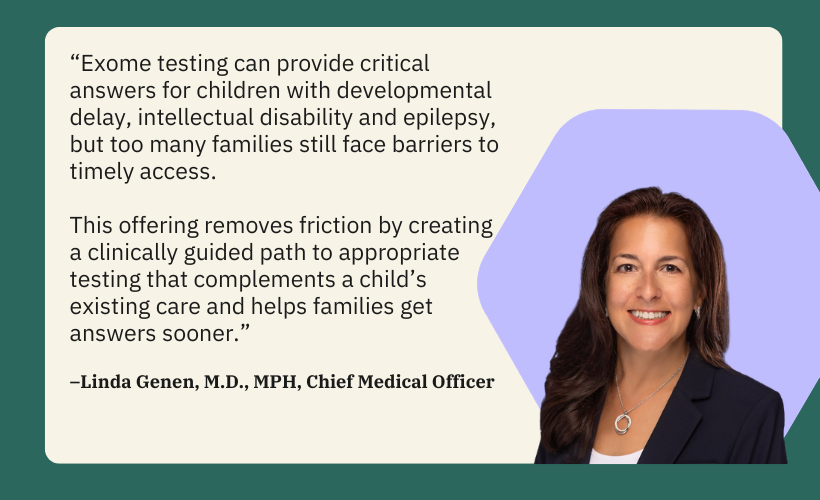
“Exome testing can provide critical answers for children with developmental delay, intellectual disability and epilepsy, but too many families still face barriers to accessing it,” said Linda Genen, M.D., MPH and Chief Medical Officer of GeneDx. “This offering removes friction by creating a clinically guided path to appropriate testing that complements a child’s existing care and helps families get answers sooner.”
Expanding Access to Precision Medicine
The launch of this offering reflects GeneDx’s ongoing commitment to expanding access to precision medicine and helping more families reach answers earlier in the diagnostic journey.
By combining evidence-based testing recommendations with a streamlined digital experience and expert clinical oversight, GeneDx is making it easier for children with global developmental delay, intellectual disability, or epilepsy to access comprehensive exome testing without unnecessary delays.
Earlier answers can help guide treatment decisions, reduce unnecessary testing, support coordinated care, and give families a clearer path forward.